From Rioja to Galicia: La Rioja Alta Founds Lagar de Fornelos
The history of Bodegas Lagar de Fornelos begins in 1988, when La Rioja Alta S.A. — one of the most renowned wineries in Spain's Rioja — was looking for a new home for great white wine in the far northwest of Spain. After ending its own white wine production in Rioja, the house acquired the small family winery Fernández Cervera Hermanos in O Rosal, near the Portuguese border in southern Galicia. The new bodega was named after the town of Fornelos and the centuries-old stone lagar — the traditional grape press — which still dominates the old part of the winery today. As a reference to the founding family, their name was retained in the flagship wine: Lagar de Cervera.
What began as a modest project with five hectares of vineyards grew over decades through persistent acquisitions — in a region where minifundism, i.e., the smallest land ownership, is the rule. Today, Lagar de Fornelos holds around 108 hectares of its own vineyards in the subzones of O Rosal and O Salnés, making it one of the largest single-estate facilities within the D.O. Rías Baixas.
Atlantic Soil, Optical Selection, Clear Cellar Intervention
The vineyards in O Rosal are located in the warmest and southernmost tip of the Rías Baixas, protected by wooded hills that keep away the morning mist and favor early, uniform ripening. The soil in O Rosal contains — unusually for Rías Baixas — slate alongside granite, which gives the wines volume and stone fruit depth. The plots in Cambados, in turn, stand on pure granite: this results in citrus freshness, salinity, and a taut vertical structure. Cellar master Olga Verde, the responsible oenologist since 2025, uses the interplay of both sites specifically for balance in the blend.
In the vineyard, the focus is on manual harvesting with pre-selection directly on the vine. In the cellar, the next step followed in 2021: Lagar de Fornelos became the first bodega in Galicia with optical sorting, which checks 100% of the grapes for quality by machine. The cellar building, opened in 2013 — integrated into the landscape with granite, an embedded stream, and native planting — reflects the same respect for the location. Verde describes the vinification itself as deliberately restrained: the goal is to bring the purity of the Albariño grape into the glass as authentically as possible, with fermentation in stainless steel tanks and subsequent fine lees contact for texture.
Two Faces of the Rías Baixas: Lagar de Cervera and Pazo de Seoane
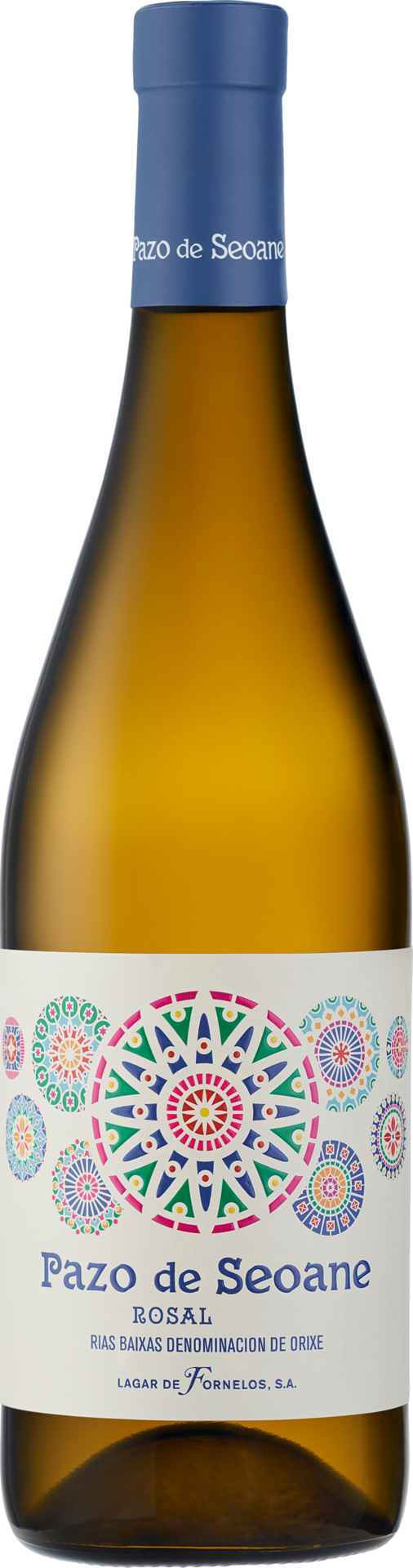
The assortment focuses on varietally pure and regionally typical white wines from the Albariño, Loureiro, Treixadura, and Caiño Blanco grape varieties. The Lagar de Cervera is a single-varietal Albariño that unites grapes from O Rosal and O Salnés: slate soil brings fullness and stone fruit, granite brings the salty freshness and tension in the finish. The Pazo de Seoane is a classic Rosal blend of about two-thirds Albariño and one-third other indigenous varieties — more complex, somewhat softer in mouthfeel. Both wines stand for the Atlantic character of the Rías Baixas: lively acidity, sea salt minerality, and aromas of citrus peel, white peach, and fresh herbs. They pair just as well with the cuisine of Galicia — octopus, scallops, grilled sea bass — as they do with Asian fish dishes or strong goat cheese.