

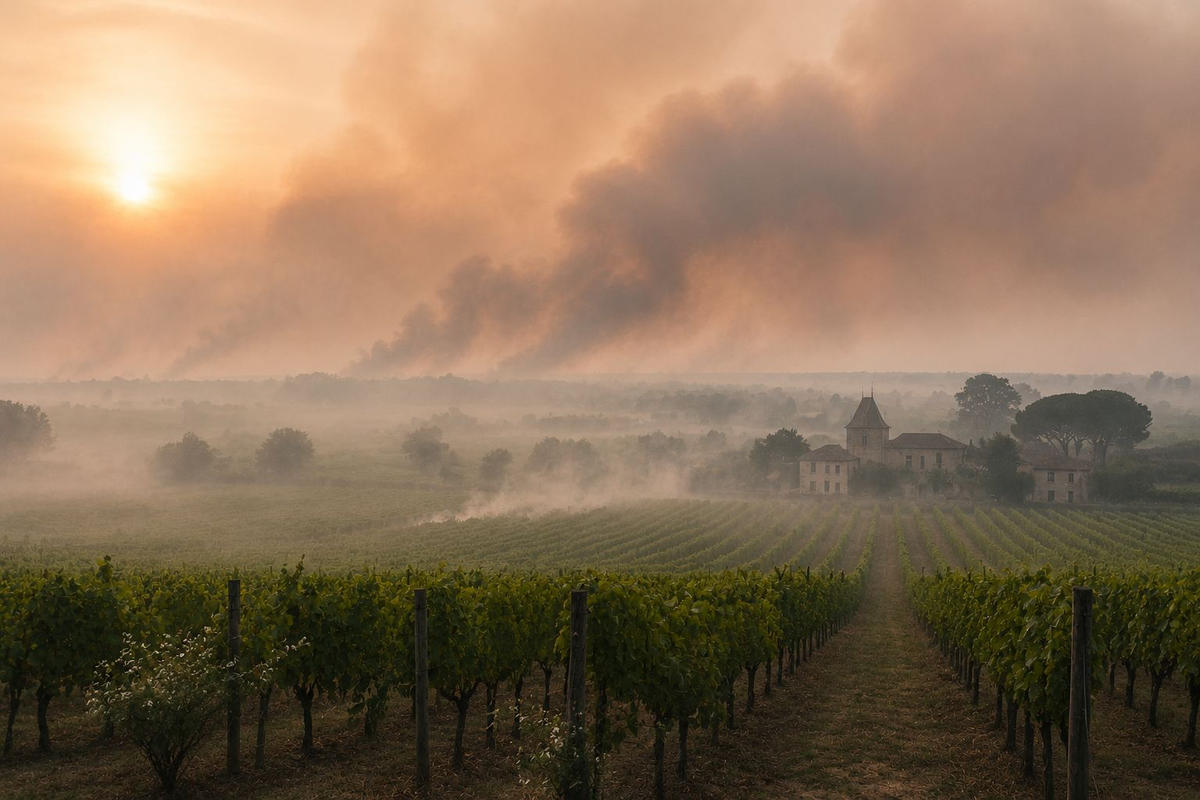
The short answer: Yes, there will be Bordeaux wine in 2026. The fear that all of Bordeaux has burned down does not correspond to reality. Most famous Châteaux and vineyards have been protected so far. Nevertheless, the current forest fires are among the most severe natural disasters the region has experienced in decades. The biggest challenge is not destroyed vines, but smoke, extreme heat, and persistent drought. Only after the harvest will it become clear how much the vintage was actually affected.
What happened in Bordeaux?
Bordeaux is one of the most famous wine regions in the world. Names like Margaux, Pauillac, Saint-Émilion, or Pomerol have stood for top-class wines for centuries. The shock was all the greater when massive forest fires spread across parts of the Gironde this summer.
Fanned by exceptional drought, high temperatures, and strong winds, the fires spread within a very short time. Thousands of emergency personnel fought the flames for days, numerous villages had to be evacuated, and large forest areas were destroyed.
The dramatic images went around the world – and with them the fear that one of France's most important wine vintages could be lost.
According to French authorities, the current fires are among the largest forest fire events of the past decades in the Gironde region.
Source: Préfecture de la Gironde / France Info
Did vineyards and Châteaux burn down?
The good news is: No.
Contrary to many headlines, most famous wine-growing areas have not been directly affected by the flames so far. The renowned appellations in the Médoc, Saint-Émilion, Pomerol, or Margaux have remained largely spared according to the current status.
However, this does not mean that the region has remained unscathed. Forests, agricultural land, and infrastructure around Bordeaux have been significantly damaged. Individual vineyards were at times in the immediate vicinity of the fire front and had to be laboriously protected.
For many winemakers, however, this was just the beginning of the real problem.
Why smoke can be more dangerous than fire
Many wine lovers assume that a vineyard only suffers damage if the vines burn.
In fact, thick smoke can have much greater effects.
While the grapes ripen in the summer, certain smoke compounds can be absorbed through the grape skin. These substances initially remain almost unnoticed and are often only released again during fermentation. In the wine world, this is referred to as smoke taint.
The result can be aromas reminiscent of cold smoke, ash, or burnt wood. Particularly treacherous: from the outside, the grapes often look completely healthy.
Scientific studies show that smoke damage often only becomes clearly recognizable during vinification or even after bottling.
Source: University of California Davis – Department of Viticulture & Enology
Can smoke damage be prevented?
Unfortunately, only to a limited extent.
Winemakers can use various methods to reduce smoke aromas. However, these measures often simultaneously remove the fruit, structure, and character of the wine.
Top wineries in particular therefore prefer to forgo individual batches or even an entire vintage rather than bring a wine to market that does not meet their quality standards. In Bordeaux, the reputation of a Château often outweighs the economic success of a single year.
Will there be a 2026 vintage from Bordeaux?
According to current knowledge, the answer is clearly: Yes.
There is currently no evidence that the entire Bordeaux vintage is lost. Rather, experts expect significant differences between individual regions and estates.
Whether a wine was actually affected by smoke later is often only decided after the harvest and during vinification. Some wineries could produce excellent qualities, while others might sort out individual batches or not market them at all.
The wine industry emphasizes that a serious assessment of the vintage is only possible after fermentation is complete.
Source: Union Girondine des Vins de Bordeaux
What are the long-term consequences of the fires?
The forest fires are part of a development that almost all major wine regions in the world have to deal with. Higher temperatures, longer dry periods, and more frequent extreme weather events are permanently changing viticulture.
Bordeaux is also already reacting. Many estates are investing in more extensive greening of the vineyards, new cultivation methods, and more climate-resistant grape varieties. At the same time, biodiversity, water management, and soil health are becoming increasingly important.
The region is in a state of transition – not away from its tradition, but towards a viticulture that adapts to the challenges of a changing climate.
Our conclusion
The images of the forest fires quickly give the impression that Bordeaux has been completely destroyed. The reality is much more nuanced.
The most famous vineyards in the region have been largely protected so far. Nevertheless, smoke, heat, and drought could leave a lasting mark on the 2026 vintage. Which wines will later be among the winners and which producers might have to forgo parts of their harvest will only become clear in the coming months.
However, one thing is already certain today: Bordeaux is facing one of the greatest challenges in its recent history. At the same time, the region proves once again why it has been considered one of the most significant wine landscapes in the world for centuries – with experience, consistency, and the uncompromising ambition to produce great wines even in difficult years.



We would love to hear what you think
What did you make of this article? Drop us a few lines — we read every comment.
Log in to join the conversation. Log in now