From a Scottish experience to a Swabian distillery address
The history of the finch whisky distillery begins with a journey: Hans-Gerhard Fink, a trained agricultural engineer and operator of a roughly 400-hectare farm on the Swabian Jura, came into contact with the craft of whisky making during a trip to Scotland – and realized that he was already growing the raw materials for a first-class whisky himself. In 1999, the first new make dripped from the spirit pipe at the Aglishardt farm, and by 2001, the first finch Swabian Highland Whisky was ready for bottling. What began as a craft experiment by a passionate farmer grew over two decades into one of the best-known German whisky distilleries. For the 25th anniversary of whisky production, Fink opened a new distillery and experience manufactory in Heroldstatt-Breithülen in October 2024 – housed in a listed fodder barn from 1898, which Emperor Wilhelm II once had built for his cavalry remount depot. The wooden construction and the original wooden facades of the building have been completely preserved.
From field to glass: control over every step
The distillery's motto is "From field to glass" – and it is meant literally. On around 400 hectares of cultivated land on the barren soils of the Swabian Jura, Fink grows the grain varieties himself that go into his whiskies: wheat, barley, spelt, emmer, and rye. Soil-conserving cultivation techniques and the harsh high-altitude climate at almost 800 meters above sea level shape the raw material. The water comes from the karst rock of the Jura. After the harvest, the distillery takes over every further production step in-house – mashing, fermenting, distilling, maturing. Depending on the variety, it is distilled up to three times in a pot still with a capacity of 3,000 liters. Maturation takes place in oak barrels that were previously used at top European and American wineries – including barrels from former sherry and bourbon storage sites. Over 5,000 barrels are currently resting in the distillery's warehouses, which, according to finch, gives them the largest stock of long-matured whiskies in Germany. The former ammunition depot on the experience grounds now serves as a bunker warehouse for some of these barrels.
Swabian Highland Whisky – variety with a clear origin
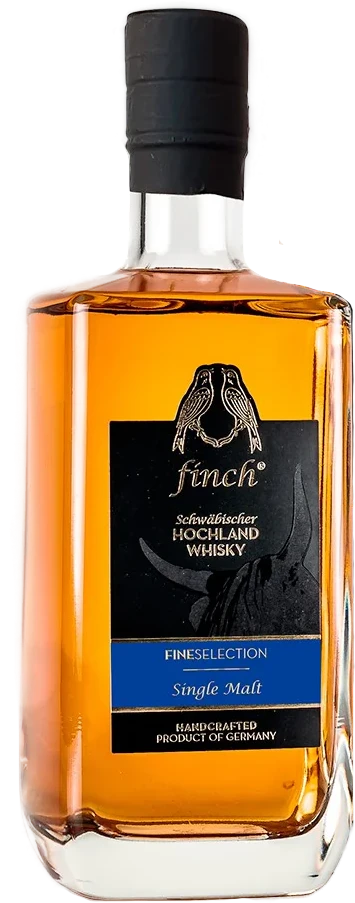
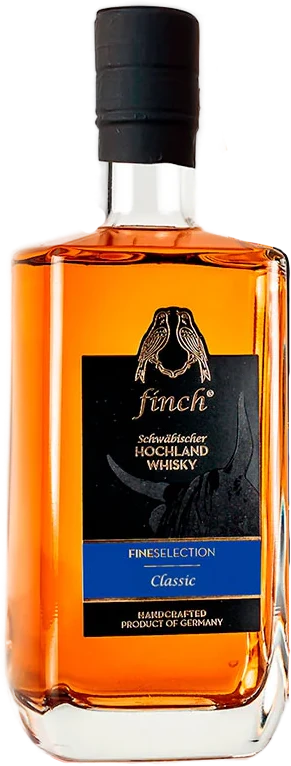
The range reflects the diversity of their own grain cultivation: in addition to the classic Single Malt made from barley, the program includes wheat, spelt, and rye whiskies as well as cask-strength bottlings and limited cask-finish editions. Currently, bottlings with up to twelve years of maturation are offered in around 14 different varieties. The basic idea remains constant: a whisky that does not deny its origin on the Swabian Jura – with the cool minerality of the karst water, the character of resilient high-altitude grain, and the warmth of long-matured barrel stock. In addition to the whiskies, Fink produces gin, vodka, and other fine brandies under the sister brand Albfink – emerging from an older fruit distillery tradition of the farm.