The man who created a wine region on horseback
It was a pioneering feat that literally began on horseback: 1870, Don Maximiano Errázuriz rode about 100 kilometers north of Santiago, had irrigation canals dug, planted the first French grape varieties in the Aconcagua Valley, and built a winery — in an area that contemporaries considered too hot and dry to produce serious wine. In doing so, he laid the foundation for a family tradition that continues to this day in the sixth generation.
The history was not straightforward. Between 1962 and 1973, Chilean land reforms forced the family to cede the majority of their vineyard area; the winery itself temporarily ended up in the hands of banks. In 1983, Alfonso Chadwick succeeded in reclaiming the run-down operation — and brought his then 24-year-old son Eduardo on board. Eduardo studied in Bordeaux, took over the management, and in 1994 was the first producer in Chile to plant commercial Syrah vines in the Aconcagua Valley. Today, he leads the winery as an active ambassador for Chilean wine worldwide; his four daughters are already involved in the company and are carrying the family history into the next generation.
Terroir thinking between the Andes and the Pacific
The house's credo can be traced back to a sentence from the founder: "From the best land comes the best wine." This approach shapes all work in the vineyard and in the cellar. The sites around Panquehue in the Aconcagua Valley benefit from a Mediterranean climate with dry, warm summers, which are moderated by winds from the Pacific and the cold Humboldt Current. The dry, warm climate makes fungal pests like mildew practically unknown — a prerequisite that allows for largely non-interventionist viticulture.
In the cellar, Errázuriz relies on gravity flow instead of pumps to treat the grapes gently. The Icon Winery Don Maximiano, opened in 2010, is designed in a spiral shape and uses geothermal temperature control as well as solar energy. All vineyards are equipped with drip irrigation and monitoring sensors. Errázuriz was one of the founders of the Chilean sustainability protocol and was the first winery in the country to export wines commercially in lightweight glass bottles.
From powerful Andean red to mineral coastal Pinot
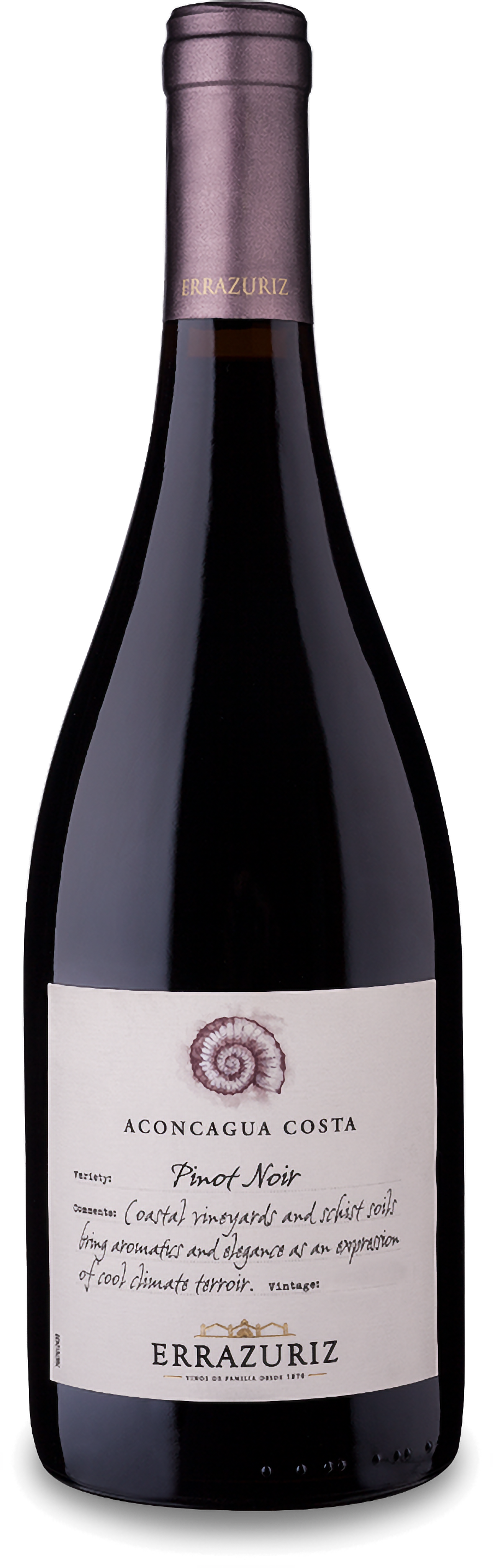
The Errázuriz range spans two climatically contrasting zones. The great red wines come from the warm, continentally influenced heart of the Aconcagua Valley: the Don Maximiano Founder's Reserve, a Cabernet-dominant blend with long aging in French oak barrels, as well as the KAI, a single-vineyard Carmenère from the estate's best lots. Opposite this is the coastal line of the Aconcagua Costa, about twelve kilometers from the Pacific, where slate and metamorphic soils give the wines a pronounced minerality.
This is where the Las Pizarras project was born — named after the Spanish word for slate. From carefully mapped individual parcels, Chardonnay, Pinot Noir, and Syrah are produced, which are spontaneously fermented, aged with a portion of whole clusters, and matured in large wooden barrels. The result is wines with a salty finish, vibrant acidity, and a freshness that was previously rarely known from Chilean coastal sites. The offer is complemented by the accessible Max Reserva line with Shiraz and other varieties from the Aconcagua Valley — dense fruit, clearly defined structure, without heaviness.