On the Duero meander, older than the appellation
Dominio Fournier is located in Berlangas de Roa in the province of Burgos, in the heart of the Ribera del Duero. The first vines were planted here in 1960, a good two decades before the D.O. was officially established in 1982. The winery itself was built in 1979. Its history thus runs parallel to the development of the Consejo Regulador.
The vineyards are not only located within the appellation boundaries, but directly by the river: in a natural meander that accompanies the Duero for around two kilometers. Since 2020, the winery has belonged to the González Byass group, which thus gained a foothold in the Ribera del Duero.
River pebbles, hand-harvesting and every parcel on its own
The estate manages around 50 hectares of Tinta del País, as Tempranillo is called in the region, spread over 22 parcels. The average age of the vines is over 25 years, with individual parcels being older than 60. The sites at over 800 meters are situated on a river terrace of scree and gravel. The soils are barren and drain strongly. This slows down the vigor of the vines and concentrates the grapes. Around half of the vines are in the traditional bush system (en vaso).
Harvesting is done by hand in 18-kilo crates. Selection takes place in the vineyard and in the cellar; the grapes pass over a sorting table and via conveyor belt into the tanks, without mechanical stress. Each parcel is vinified separately in small tanks. Malolactic fermentation takes place in barriques, with frequent stirring of the lees. At the time of the takeover in 2020, oenologists Marian Santamaría and Laura Terrazas were responsible for the aging process.
Tinta del País with structure: Reserva and Crianza
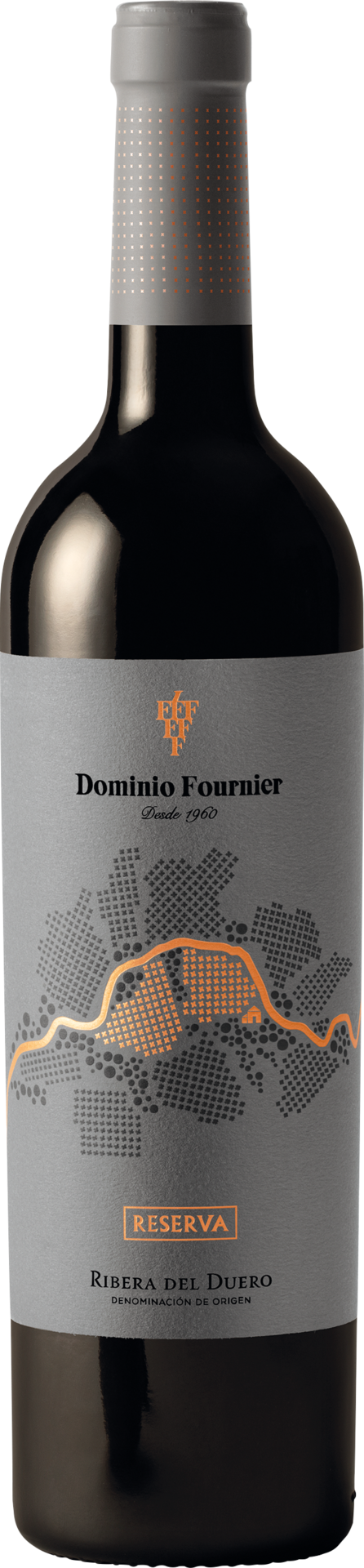
The Reserva consists of 100% Tinta del País and matures for at least 18 months in French oak barriques. The 2020 vintage shows ripe black fruits, toffee, graphite and a hint of black licorice. On the palate, it appears broad and dense, with a long, elegant finish. Serve it at 16 to 18 °C. It goes well with roast beef, lamb, game, braised dishes or mature cheese.
Production remains small; the house itself speaks of limited quantities and manual labor. In addition to the Reserva, Dominio Fournier bottles a Crianza. Both wines bear the hallmark of their origin: powerful and structured, with the freshness brought by the nearby river and the high altitude.