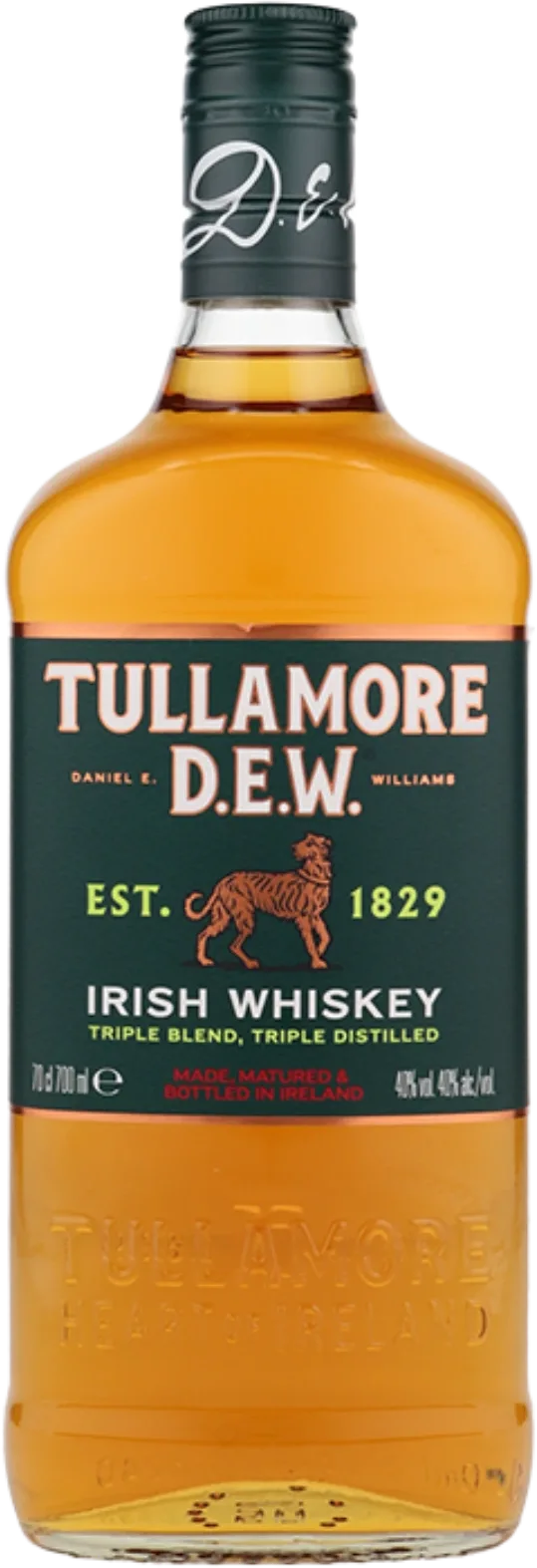
From Molloy to Williams: 1829 and the birth of an Irish legend
The story of Tullamore D.E.W. begins in 1829 in Tullamore, the county town of County Offaly in the heart of Ireland. There, Michael Molloy founded a distillery, which was initially continued under the name of his nephew Bernard Daly. The decisive step was taken by Daniel Edmund Williams (1848–1921), who joined as manager and eventually took over the distillery. Williams was much more than a whiskey man: he brought electricity, telephone, and the first motor vehicle to Tullamore — his delivery van. He operated a chain of 26 grocery stores, imported tea, and turned Tullamore into a regional trading center. His surname is still on every bottle today: D.E.W. are his initials, Daniel Edmund Williams.
In 1954, the original distillery closed, and the brand changed hands several times in the following decades — via John Powers & Son to Irish Distillers and finally to the C&C Group. In 2010, William Grant & Sons, the Scottish family distillery, bought the brand. In 2014, a completely newly built distillery opened on a greenfield site on the outskirts of Tullamore — the first of its kind in Ireland in over 100 years. Thus, after 60 years, production returned to the town from which the whiskey takes its name.
Three times three: the craft behind the Tully
The principle on which Tullamore D.E.W. is built can be described with three numbers: three grain types, triple distillation, three cask types. It is distilled in four copper pot stills in Tullamore; the grain whiskey portion of the blends is currently still sourced from Midleton in County Cork, as a Coffey still is not yet in operation in Tullamore. The triple blend principle — pot still, malt, and grain whiskey are stored together and then assembled — goes back to the production philosophy that Williams established in the early 20th century and which he carried into the world with the first US export in 1954.
Maturation takes place in a combination of used bourbon casks, ex-sherry butts, and classic refill barrels. The result is not a random compromise, but a calculated interplay: each cask type contributes its own layer — vanilla and caramel from bourbon wood, dried fruits and light spice from the sherry, grain notes from the refill. Bottling and maturation take place on the distillery grounds in Tullamore itself.
The range: from accessible blend to aged single malt
The heart of the range is the Tullamore D.E.W. Original (40% ABV) — a triple blend of triple-distilled pot still, malt, and grain whiskey, matured in ex-bourbon and sherry casks. Grain whiskey provides the bright sweetness, malt brings fruitiness, pot still gives the spice typical of Irish whiskey. Neat, with ice, or with a splash of ginger ale — the base expression is deliberately kept without rough edges.
In addition, the program includes a 12-Year-Old Special Reserve with an increased pot still and malt content, as well as a 14-year-old single malt that undergoes a finish in port, Madeira, and Oloroso sherry casks after maturation in bourbon casks. For lovers of rum aromas, there is a Collector's Edition with a Caribbean rum cask finish. Every bottling bears the initials D.E.W. — a silent tribute to the man who turned a provincial trading business into one of the best-selling Irish whiskey brands in the world.