From state distillery to the world's largest Aquavit producer
The history of Arcus does not begin with a founding family, but with a state heirloom. When Norway split its state spirits monopoly Vinmonopolet in 1996, the newly founded company Arcus took over all production, import, and export activities – including the recipes and stocks that had been accumulated over decades. Among them were formulas that date back to the purchase of the traditional Løitens Brænderi in 1927. The company's headquarters are in Hagan, north of Oslo, where production and storage still take place on the Destilleriveien site today.
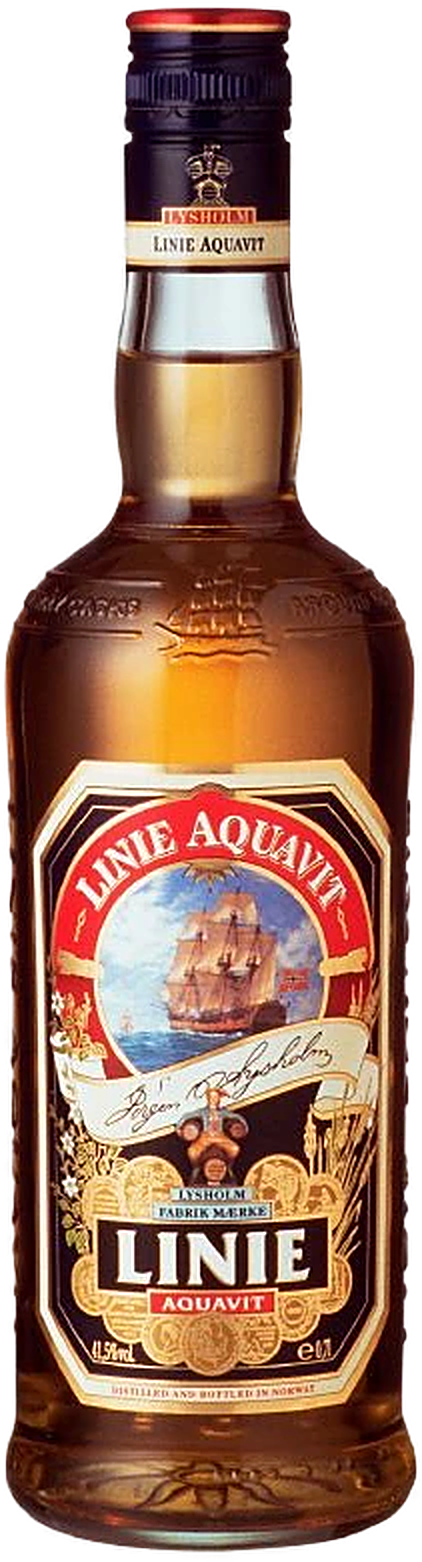
The history of Arcus inevitably includes the Lysholm family from Trondheim. It was they who sent a ship with barrels of potato aquavit to the East Indies in 1805. The business failed because the goods found no buyers on site and returned unsold. But when the barrels were opened in Norwegian ports in 1807, the aquavit was barely recognizable: the months of rocking, the temperature fluctuations between climate zones, and the influence of the salty sea air had fundamentally changed the character of the spirit – rounder, deeper, more complex. Jørgen B. Lysholm, the nephew of the merchant Catharina Lysholm, recognized the potential, refined the process, and officially launched LINIE Aquavit on the market in 1821. As the owner of the brand, Arcus is now responsible for this over 200-year-old heritage.
Distillation craft between Norwegian potato and Danish herbal knowledge
Arcus works according to clearly defined craft principles: the raw material for Norwegian aquavit is legally prescribed – at least 95 percent of the base spirit must be obtained from Norwegian potatoes. The potato spirit is then pumped into the distillation plant with water and spices, brought to boiling temperature, and collected as an aromatic distillate. The result is a clear spice extract that forms the basis of every bottling. In the warehouse in Hagan, around 8,000 oak barrels mature simultaneously – aquavit of different ages, from six months to twelve years.
For the Gammel Dansk Bitter Dram, which was originally developed in 1964 by the Danish blender J.K. Asmund at Danske Spritfabrikker in Roskilde, the craft lies in a different discipline. For three years, Asmund tested over a hundred herbal substances before he found the balance: 29 herbs, flowers, and spices – including angelica root, nutmeg, anise, ginger, rowan berries, gentian, and Seville oranges – are distilled and macerated, then stored in tanks for three months before bottling at 38% vol. No single aroma must predominate; the goal was and remains a bitter that remains sharp and at the same time harmonious. Production of the brand was moved to Norway in 2015; nothing has changed in the recipe.
LINIE, Løiten and Gammel Dansk – a range with attitude
The core of the Arcus range is the LINIE Aquavit: caraway and star anise as the leading botanicals, distilled in a pot still, then stored for one year in Oloroso sherry barrels – and subsequently four months at sea. The barrels cross the equator twice on board Wallenius-Wilhelmsen cargo ships, which call at more than two dozen ports in America, Latin America, and Asia. The constant movement of the waves rhythmically presses the spirit into the wood and out again, and the changing temperatures between the climate zones accelerate the exchange. What comes back has a light amber color, a creamy texture, notes of caraway, star anise, vanilla, and a hint of sherry on the finish. The ship's name, departure date, and route are printed on every bottle – a seamless provenance that is rare in the world of spirits.
Next to it is the Gammel Dansk Bitter Dram: in Denmark a celebratory ritual for Christmas, Easter, birthdays, and hunting trips, in the bottle a dark brown glowing bitter with pepper, cinnamon, and clove in the aftertaste, a tart Juniperus tannin structure in the middle, and a long, slightly sweet licorice swing on the finish. Neat, at room temperature, in small glasses – that is how it is traditionally drunk.