From the Tübingen school desk to Burg Bartelstein
Paul Martin and Leonard Vinçon — Paul and Leo in everyday life — have known each other since their school days in Tübingen. After their studies, both were drawn into the world separately: tea ceremonies in China and Japan, spice markets in Latin America, gourmet culture in European metropolises — each station sharpened their view of what a non-alcoholic drink could achieve, but had not yet achieved. Back in Germany, they began to experiment, and seriously: thanks to the family's own manufactory, they were able to draw on more than 15 years of experience in beverage production. What followed were nights of test series until the first batch could be bottled — at a small castle in the south of Germany, which still gives the company its legal name today: Burg Bartelstein GbR, based in Kiebingen near Kusterdingen.
The brand name is based on a story that both founders understand as a guiding principle: a namesake named Franz von Fein is said to have welcomed guests from all over the world to this very castle in the 1920s — open, curious, with a knack for colorful tonics and herbal extracts from his own garden. This attitude — hospitality, cosmopolitanism, sensory care — is the content-related foundation on which Leo and Paul have built their brand.
Small batches, consistently natural ingredients
Production takes place in their own manufactory in Kiebingen, where every batch is created by hand. The basis is organic fruits, herbs, and spices without artificial flavors or colors. The ingredients are macerated and gently extracted to preserve the full aroma — a process known from classic herbal liqueur and bitter production, but here consistently without alcohol as a solvent and preservative. The conscious decision for small batches is not a marketing argument, but an artisanal necessity: maceration and extraction can hardly be controlled with the same precision on a large scale.
Leo and Paul do not see Franz von Fein as an isolated product, but as a platform for artisanal gourmet culture. The Tasting Room in Munich's Westend, Schwanthalerstraße 141, is an expression of this philosophy: a place where non-alcoholic enjoyment can be experienced not as a renunciation, but as an independent sensory category.
Ruby, Amber, and sparkling tea cuvées
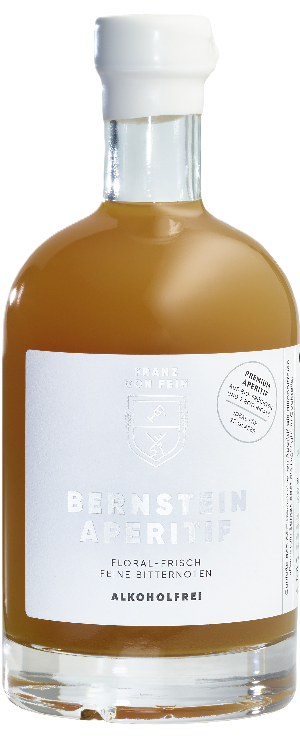
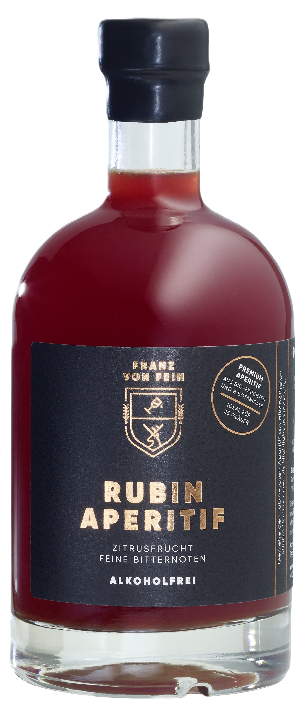
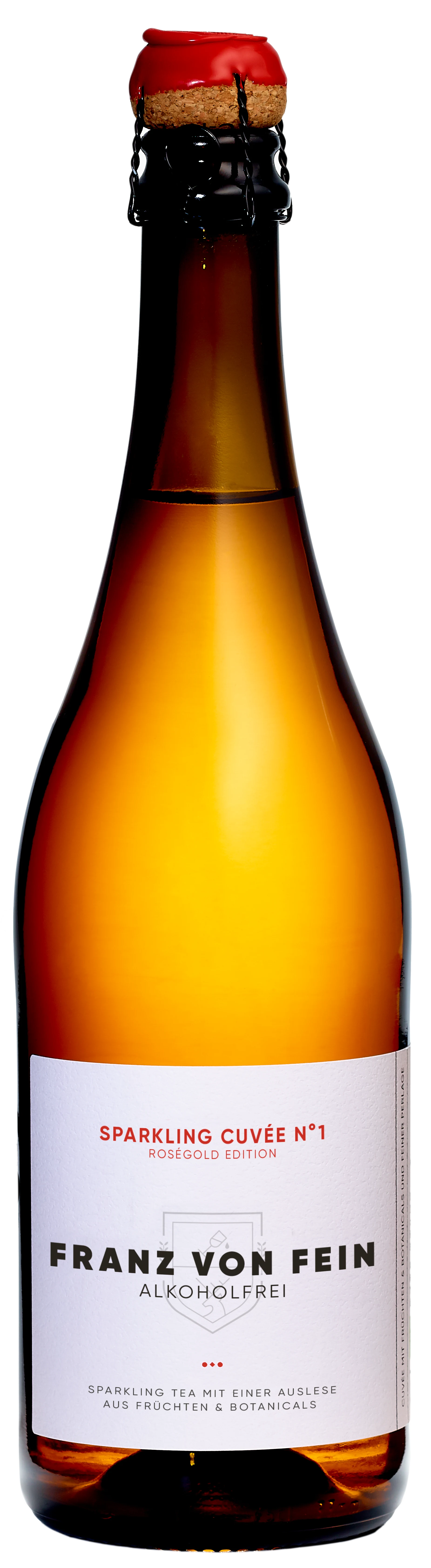
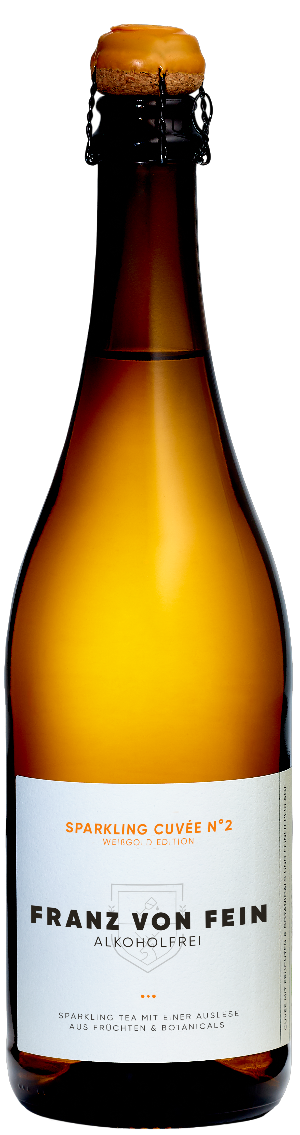
The range is divided into two aperitif lines and a sparkling tea series. Rubin works with hibiscus, organic lemons, and juniper berries — this results in a fruity-tart-bitter structure with a red color and a clear line of acidity. Bernstein relies on organic oranges, lavender, and rosemary: fruitier, more floral, with a warming herbal finish. Both aperitifs work neat on ice, as a base for non-alcoholic spritz variants, or as a building block in more sophisticated mocktails. The sparkling teas — Roségold Edition Cuvée Nº1 and Weißgold Edition Cuvée Nº2 — expand the range with sparkling, tea-based alternatives for festive occasions. All products carry organic certification; the World Alcohol Free Awards 2024 awarded Rubin and Bernstein gold, and the Falstaff Spirits Special 2024 awarded 93 points.